High Pressure Drone Cleaning System for Skyscrapers
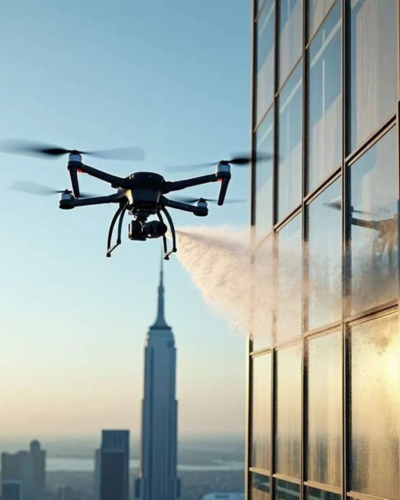
Maintaining skyscrapers in busy cities is challenging with traditional methods like scaffolding and rope access—often slow, risky, and costly. We offers a smarter solution: autonomous drones with high-pressure water jets for fast, safe, and eco-friendly cleaning of glass façades and complex high-rises.

The Skyscraper Cleaning Challenge
Height & Complexity: Reaching all surfaces of 50+ story buildings often requires extensive rigging and highly trained personnel.
Safety Concerns: High-altitude manual cleaning poses significant risks, especially in windy or unpredictable weather.
Operational Disruption: Weeks-long cleaning schedules disrupt tenants, block footpaths, and interfere with traffic.
Environmental Cost: Traditional cleaning consumes excess water and harsh chemicals, raising environmental and compliance issues.
Introducing Our Drone-Based High-Pressure Cleaning System
Our drone-powered cleaning platform eliminates risky manual labor. Using intelligent navigation, high-pressure jets, and eco-safe cleaning agents, our drones clean skyscraper façades with unmatched precision—without a single technician leaving the ground.
How It Works
Precision Surveying: Using 3D LiDAR and photogrammetry, drones map every nook of the façade.
Flight Optimization: Smart software generates flight paths based on surface layout and soil density.
Targeted Cleaning: Adjustable 50–200 bar water jets with biodegradable detergent remove dirt and grime safely.
Live Monitoring: Real-time video and telemetry allow adjustments mid-mission.
Post-Clean Inspection: Drones capture 12MP images to verify cleanliness and highlight any maintenance issues.
Features
Autonomous Flight Modes: GPS-denied navigation with obstacle avoidance and emergency return.
Adjustable Water Pressure: Ranging from 50–200 bar for all surface types, including low-E or tinted glass.
Eco-Friendly Cleaning System: Low-flow nozzles (8–12 L/min) and soft detergents reduce runoff and water waste.
360° HD Visual Inspections: Integrated cameras enable façade documentation for audits and maintenance tracking.
Quick-Swap Batteries & Modular Tanks: Streamlined operations for large structures.
Applications
Commercial Skyscrapers
Office towers, mixed-use high-rises, and corporate campuses with extensive glass façades.
Residential High-Rises
Apartment complexes and condominiums seeking efficient window washing and balcony cleaning solutions.
Hotels & Hospitality
Hotel towers, convention centers, and luxury resorts requiring impeccable exterior aesthetics.
Government & Institutional Buildings
Civic centers, museums, and educational campuses with architectural complexity.
Landmark Structures
Architectural icons—complex geometries or curved sections that challenge traditional access methods.
Solar Panel Arrays
Roof-mounted or façade-integrated photovoltaic panels on high-rise structures, where dust and bird droppings reduce efficiency.
Technical Specifications
| Parameter | Specification |
|---|---|
| Drone Frame Weight | 11.8 kg (with empty water tank) |
| Battery Duration | 25 minutes (max payload) |
| Water Module Capacity | 10 liters (quick-swap design) |
| Nozzle Pressure Range | 50 – 200 bar (adjustable) |
| Flow Rate | 8 – 12 L/min (optimized for minimal usage) |
| Detergent Injection Raten | 0.5 – 1 L/min (biodegradable cleaning agent) |
| Max Operating Wind Speed | 15 km/h (with auto-hover freeze above 12 km/h) |
| Control Range | 1 km line-of-sight; 300 m GPS-denied mode |
| Camera Resolution | 12 MP HD RGB + Infrared for stain detection |
| Obstacle Sensing | Lidar & Ultrasonic (3 m range) |
| Payload Mount | Quick-release boom with 360° swivel nozzle |
Why Choose Us
With over 5 years of hands-on R&D in autonomous cleaning systems, our engineers specialize in fluid mechanics, flight control, and computer vision—ensuring reliability even in dense urban conditions.
From curved aluminum panels to reflective low-E glass, we customize nozzle pressure, detergent mix, and cleaning strategy for each surface—guaranteeing results without damage.
We offer certified training, 24/7 remote diagnostics, firmware updates, and preventive maintenance planning.
- DGCA-compliant airframes with restricted area clearances
- ISO 14001-compatible cleaning agents
- Triple-redundant pressure pumps and hover-freeze fail-safes
FAQ - High Altitude Cleaning Drone System
What is a High Pressure Drone Cleaning System for Skyscrapers and how does it work?
A High Pressure Drone Cleaning System for Skyscrapers uses a drone equipped with controlled water pressure, intelligent navigation, and live monitoring to clean exterior surfaces on tall buildings. It is designed to remove dirt, pollution, bird droppings, and surface buildup from glass, cladding, and other facade materials while reducing the need for manual work at height.
Is a Skyscraper Cleaning Drone System safer than scaffolding or rope access?
A Skyscraper Cleaning Drone System can reduce worker exposure to height-related risks because operators stay on the ground during cleaning. However, safety still depends on site planning, trained operators, weather limits, exclusion zones, and the condition of the building surface. It should be viewed as a safer alternative in many cases, not a risk-free method.
Can Drone Cleaning for Super Tall Buildings fully replace rope access or suspended platforms?
Drone Cleaning for Super Tall Buildings can reduce the need for rope access or suspended platforms on many maintenance-cleaning jobs, but it may not replace them in every situation. Some buildings may still require traditional access for deep restoration, manual detailing, repair work, or areas where drone operation is restricted.
Is an Ultra Tall Structure Cleaning Drone safe for coated, tinted, or low-E glass?
An Ultra Tall Structure Cleaning Drone can be used on coated, tinted, or low-E glass when the water pressure, spray angle, nozzle type, and stand-off distance are carefully adjusted. Before cleaning starts, the facade condition, coating sensitivity, and sealant condition should be checked to avoid damage.
What surfaces can a High Altitude Cleaning Drone System clean on skyscrapers?
A High Altitude Cleaning Drone System can be used on many exterior surfaces, including glass facades, cladding panels, architectural glazing, metal sections, and selected hard-to-reach vertical surfaces. Suitability depends on the material type, surface condition, contamination level, and whether the facade has delicate coatings or damaged joints.
How long does a project take with a Drone Washing System for Mega Towers?
Project time depends on the height of the building, total facade area, surface type, contamination level, water supply access, and weather conditions. A Drone Washing System for Mega Towers can often reduce setup time compared with traditional methods, but the exact cleaning duration should be estimated after a site survey.
Can a Supertall Tower Cleaning Drone work in windy weather?
A Supertall Tower Cleaning Drone can only operate within approved weather and wind limits. Wind speed, gusts, turbulence around tall structures, rain, and visibility all affect whether cleaning can continue safely. If conditions exceed the allowed threshold, the drone operation should pause, hover, or return to base according to the site safety protocol.
Do I need permits or approvals for an Aerial Cleaning System for Tall Structures?
In many cases, yes. An Aerial Cleaning System for Tall Structures may require approvals depending on local drone rules, airspace restrictions, building location, public safety conditions, and work-zone requirements. Commercial projects should always be reviewed in advance to confirm what permissions are needed before cleaning begins.
How do you manage runoff and wastewater with a Drone System for Vertical Megastructures?
A Drone System for Vertical Megastructures should be used with a site-specific runoff and wastewater plan. This may include controlled detergent use, low-flow spray settings, collection methods, filtration, or approved disposal procedures depending on the project requirements and local environmental rules.
Will a High Elevation Cleaning Drone System remove all stains from landmark towers or urban high-rise buildings?
A High Elevation Cleaning Drone System is effective for removing routine dirt, dust, bird droppings, pollution residue, and surface buildup from landmark towers and urban high-rise buildings. However, deep mineral stains, oxidation, failed coatings, and embedded marks may need specialist restoration rather than standard drone cleaning alone.